

Finding summer-ready linen trousers should feel effortless, yet for anyone under 5'4", the search often ends in dressing room frustration. Standard-sized linen trousers arrive with floor-dragging hems, droopy rises that throw off your natural waist, and voluminous legs that quickly swallow a shorter frame. Add the unpredictable opacity of unlined summer weaves and the looming fear of post-wash shrinkage, and most petite shoppers end up dreading the tailor's bill before they even make a purchase. Achieving an airy, relaxed silhouette does not require drowning in excess yardage or resigning yourself to stiff alterations. Understanding how rise, volume, fabric weight, and lining intersect allows petite frames to embrace breezy linen trousers that elongate your silhouette and hold their shape with understated elegance.
The Petite Linen Dilemma: Why Standard Sizing Fails Shorter Frames
Every summer, discussions across petite styling forums such as Reddit's r/PetiteFashionAdvice echo the same recurring grievance: off-the-rack linen trousers rarely accommodate petite anatomy. Linen is celebrated for its casual drape, open weave, and effortless drape, but those very characteristics make mass-market sizing perilous on shorter bodies.
When apparel brands cut linen pants for an average height of 5'6" or taller, they design around longer vertical spans: a deeper crotch curve, knee points positioned inches below where your knee actually bends, and hems trailing several inches past your feet. The result is not an airy, effortless outfit, but an overwhelming garment that swallows your natural silhouette.
The Inseam and Rise Trap: Why Sizing Down Doesn’t Solve Proportional Fit
A common mistake when shopping for summer trousers is simply sizing down in regular collections—choosing an XS or size 2 instead of your normal size 4. While this narrows the waistband, it completely overlooks the underlying architecture of a garment.
- The Dropped Crotch Effect: Standard rises (often measuring 11 to 13 inches) are graded for longer torsos. On a petite frame, that excessive depth creates an unflattering sag between the thighs, shortening your apparent leg line and causing fabric to bunch when walking.
- Misplaced Knee Breaks: Trousers designed with subtle tapering or a gentle flare taper at mid-calf instead of your true knee, producing awkward folds around the lower legs.
- Constricted Waist and Hips: Sizing down tightens the hip and waist circumference without altering vertical proportions. You end up with a restrictive waistband, pulled pocket seams, and excess hem pooling on the floor.
As petite style analyst Brooke from Pumps & Pushups notes in her empirical garment testing, true petite design is never just about lopping three inches off the bottom of a pant leg. Proportional grading requires recalculating the rise, shortening the distance from waist to hip curve, and adjusting thigh circumferences to maintain structural harmony.
The Transparency Problem: Why Lightweight Summer Linen Needs Strategic Lining
Beyond architectural proportions, petite shoppers face a second barrier that renders many linen pants unwearable: sheer, see-through fabric.
Because linen is naturally derived from the flax plant (Linum usitatissimum), summer-weight linen often features a loose, breathable weave. In unlined neutral or light-toned trousers—such as oat, ecru, or crisp white—this airy weave becomes practically transparent in natural daylight:
- Pocket Bag Shadows: Standard white linen trousers frequently display stark white pocket bags shining straight through the front thighs, creating distracting visual blocks that cut off vertical leg lines.
- Undergarment Show-Through: Even skin-toned seamless undergarments often cast noticeable silhouettes under direct sunlight when fabric lacks interior opacity.
- The Unwanted Heat Dilemma: Many brands attempt to fix this issue by simply doubling the weight of unwashed linen fabric, which inadvertently stiffens the drape and traps unwanted body heat.
A thoughtful solution is strategic interior lining. Rather than relying on heavyweight, stiff canvas, properly engineered petite linen trousers feature an ultra-lightweight, breathable viscose or cotton lining running through the thigh. This design keeps the pant completely opaque under bright summer sun while preserving the cool, breezy drape that makes linen so desirable.
4 Essential Fit Rules When Shopping for Petite Linen Pants
Shopping for warm-weather trousers as a petite requires a discerning eye for balance and tailored construction. When you evaluate prospective pairs, keeping four foundational proportion rules in mind ensures your pants flatter your frame directly off the rack.
Proportional Rise: Why High-to-Mid Rises Elongate Shorter Legs
The rise of a pant—the vertical distance from the crotch seam to the top of the waistband—sets the visual baseline for your lower body.
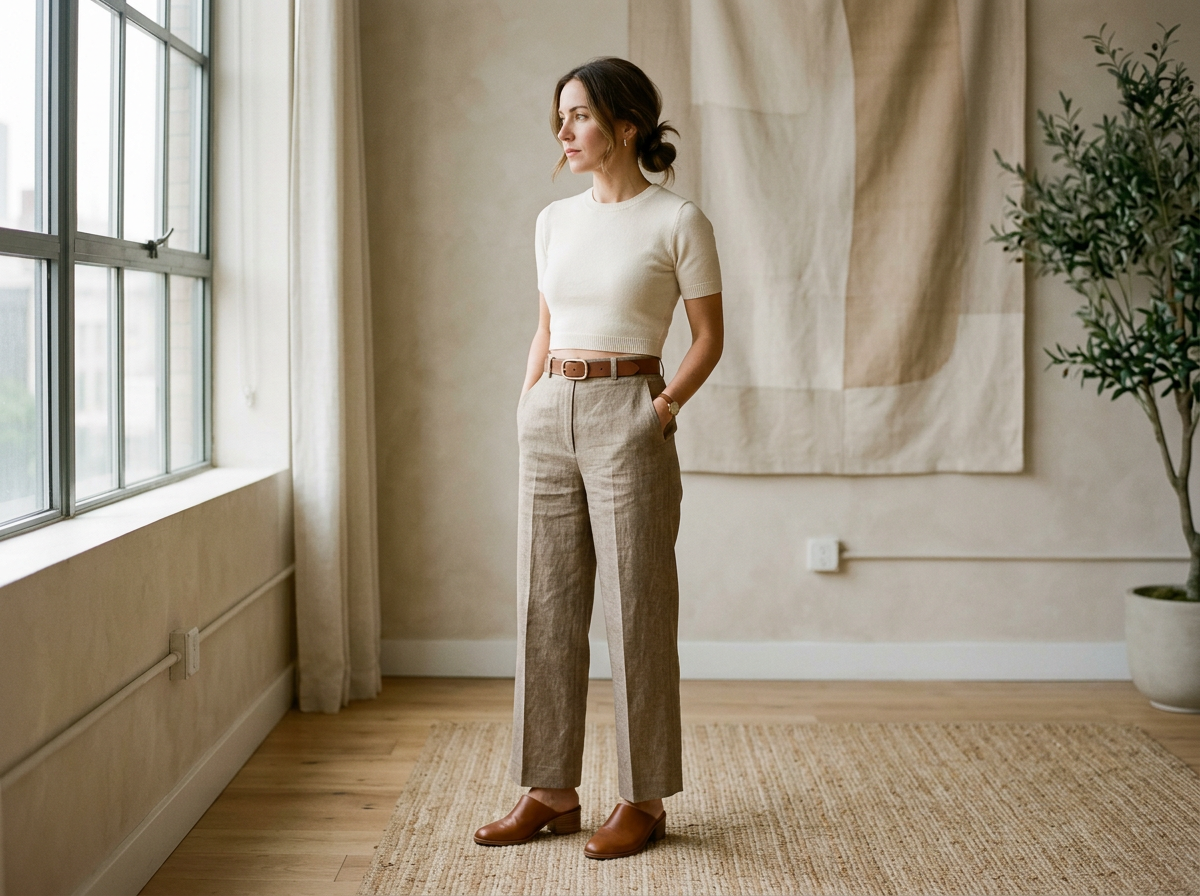
On petite frames (typically 5'4" and under), a proportional high-to-mid rise (9.5 to 10.5 inches) positions the waistband right at or just below the narrowest point of your natural waist. As highlighted by petite style editor Beth at SAS for Short, elevating the waistline visually lengthens the leg line, creating an uninterrupted vertical sweep that offsets the wider cut of a summer pant.
Be cautious with ultra-high rises exceeding 11.5 inches designed for standard sizing; on shorter torsos, an exaggerated rise compresses the ribcage and makes the bustline appear uncomfortably close to the waistband.
Controlled Volume: Choosing a Structured Wide Leg Over Oversized Balloon Cuts
Wide-leg linen trousers are a staple of summer minimalism, but excessive volume is the easiest way to overwhelm shorter proportions:
- Oversized Balloon Cuts: Pants that bow outward dramatically at the hips or flare excessively from the upper thigh create horizontal visual width. On shorter frames, this horizontal expansion cuts your vertical height.
- Controlled Wide Legs: Seek a trouser that fits cleanly through the hips and rear before falling in a straight, fluid column from the widest point of your thigh down to the hem.
- Vertical Seaming and Pleats: Soft front pleats or subtle vertical stitching guide the eye upward, giving fluid linen fabric structural discipline without sacrificing breathability.
The Inseam Sweet Spot: Ankle-Skimming vs. Slight Shoe Break
Hem length dictates whether a pair of linen pants reads as sophisticated or disheveled. The ideal petite inseam generally falls between 25 and 28 inches, depending on your specific leg-to-torso ratio and preferred footwear:
|
Hem Style |
Target Petite Inseam |
Best Footwear Pairing |
Visual Impact |
|---|---|---|---|
|
Ankle-Skimming (Cropped) |
24" – 26" |
Flat slides, pointed mules, minimalist sneakers |
Shows the delicate ankle bone; keeps hems pristine on wet pavement |
|
Slight Shoe Break (Full-Length) |
26.5" – 28" |
Low block heels, woven platform sandals, espadrilles |
Grazes the top of the shoe vamp; maximizes vertical leg elongation |
|
Floor Pooling (Avoid) |
29"+ (unaltered standard) |
N/A |
Causes tripping, collects street dirt, and crumples into heavy ankle folds |
If you plan to wear flat sandals most of the summer, aim for an inseam that hovers 0.5 inches above the ground when barefoot. This preserves a clean line while preventing the hem from dragging.
Waistband Engineering: Tailored Waistbands and Adjustable Internal Straps
Traditional elastic pull-on waistbands are undeniably comfortable, but thick, gathered elastic bunches heavily around the midsection, creating bulk right where petite styling calls for a streamlined profile.
Look instead for thoughtful waistband construction:
- Flat-Front Waistbands: A clean front panel lies smooth against your abdomen, making tucked-in tanks and button-down shirts drape effortlessly.
- Elasticized Back Panels: Back elastic offers forgiving flexibility throughout the day while maintaining a crisp, tailored look from the front.
- Internal Adjustable Straps: High-end petite trousers often incorporate hidden interior waist adjusters or button tabs. This allows you to tighten or loosen the waistband by an inch or two across the day without needing a belt or a trip to the tailor.